
"What do you think about talking to AI about topics one might discuss with a therapist?"
AMA #4 || As Avril would say, "… Why'd you have to go and make things so complicated?"

hi!! You’ve found yourself at dialoguing, a newsletter where I talk about life sometimes through the lens of my day job (I’m a psychotherapist) in the least clinical way possible. As the name of this newsletter suggests, I’m conscious of how we talk. to oneself, to each other, in and about pop culture.
One thing before we jump in, I show up very much as myself here. Myself first, and all my other labels are secondary. If a therapist speaking candidly feels like too much to your system, that is absolutely is OK and this may not be the best particular newsletter for you.1

Today’s newsletter is a AMA full of questions that can only be described as a mishmash.

I found myself sort of bracing at my bluntness in response—or at least, it feels blunt to me. A reminder that these are my opinions. I suspect many colleagues will and can disagree with me about these perspectives.
If you missed our previous AMA’s:
⚫ What would you say to someone starting in the therapy field? What do you wish you knew?
This question is an amalgamation of one I got many, many times—the most asked type of question, actually.
First I’d say, I think going to graduate school to be a therapist2 can lead to tremendous insight and deepening in our skills of relating to oneself and others. In my experience, it also led to really rich relationships and opportunities to connect with people in a way I never had before.
There are three things that come to mind for me that are less gushing and more frank considerations that fall under “What I wish I knew?”:
(1) How much of being with other people in pain is learning how to be with your own. Period. You can want to “help” to the coriest core of yourself, but the humbling truth is we have to reckon with our own selves. Be prepared to be in your own therapy and consultation for most of your life. This is not a bad thing, at all, just a thing to come to terms with.
(2) The further I get into this career the more I am contending with the parts of me who hoped therapy was a panacea, a (gasp) dogma. Therapy is an amazing tool.
Or a type of relationship would be a way I’d prefer to say it actually.
Truly, life-changing in many ways. It’s how I want to be in connection with others, sharing my gifts and all that, but it’s not the end. Nor is it the answer to all our questions.
It’s not the cure to our collective pain, for the suffering so many of our fellow humans have faced, continue to face.
As Jennifer Mullan, Psy. D., writes in Decolonizing Therapy: Oppression, Historical Trauma, and Politicizing Your Practice:
“It is crucial to be clear that therapy, as it stands in this space paradigm and time, is NOT a substitute for systemic and structural change.”
I’d read her book and other books like it that bring a bird’s eye view to the profession (which includes being necessarily critical) and the way it has caused explicit harm, perpetuated the oppression of intentionally exploited communities,3 and promoted itself as universal remedy.
This can be mind-bending, paradigm shifting work to do and I’ve come to see it as essential and incredibly additive to my role as a therapist—because it has helped me center my humanity over the clinician.
(3) While I know exactly zero colleagues who came into this field to become wealthy, it doesn’t mean that one shouldn’t be informed about the economic reality of being a mental health professional and what one gets paid. If you plan to work for an agency, do research about what that type of work pays and what the expectations are (e.g., how many clients, how much paperwork), read Glassdoor reviews, get on Reddit. If you plan to own your own private practice, use one of these kinds of calculators to determine what your fee would need to be—I guarantee it will shock you.
If you’re anything like me, you will need to do this research slowly. It’s a lot to take in and engages a different part of my brain that can get overwhelmed quickly. Some of what you will find will be encouraging, other parts will be depressing. This is all important to get a full picture–so we can feel empowered about what sort of support and skills we need to nurture.
⚫ What do you think about talking to AI about topics one might discuss with a therapist?
I have two responses to this question.
The first is the therapisty response: I would want to hear more about how this person got there? I’d be curious about their why and what they are getting from it, about the constraints that keep them from exploring these things with a therapist or even a friend, etc.
The second response is my personal stance which is: I fuck with AI as little as possible.
I can chit chat about almost anything, but my husband and I often joke that there are two topics I struggle to stay engaged with and they are 🥁🥁🥁🥁🥁🥁🥁🥁:
Space and AI.
Despite having seen Armageddon perhaps more than any other human,4 I have a real aversion to spending time thinking about outer space. I watched Hail Mary Project last night and I was white-knuckling it the whole time. Not even the charms of Ry Gos could calm me. It just freaks me out. There is too much there, there.
AI is the same for me. I’m avoiding it the way I harp on people for avoiding their emotions. I can see that, but/and I just want to be honest here. Clearly not a solution, just a reality. My ignorance of how this all worked has resulted in me discovering lots of ways I’m using AI and didn’t even realize it5 and lack of clarity on it’s impact on our planet.6
I probably need to be more informed about it, but I’m currently at the Ayo Edebiri stage.
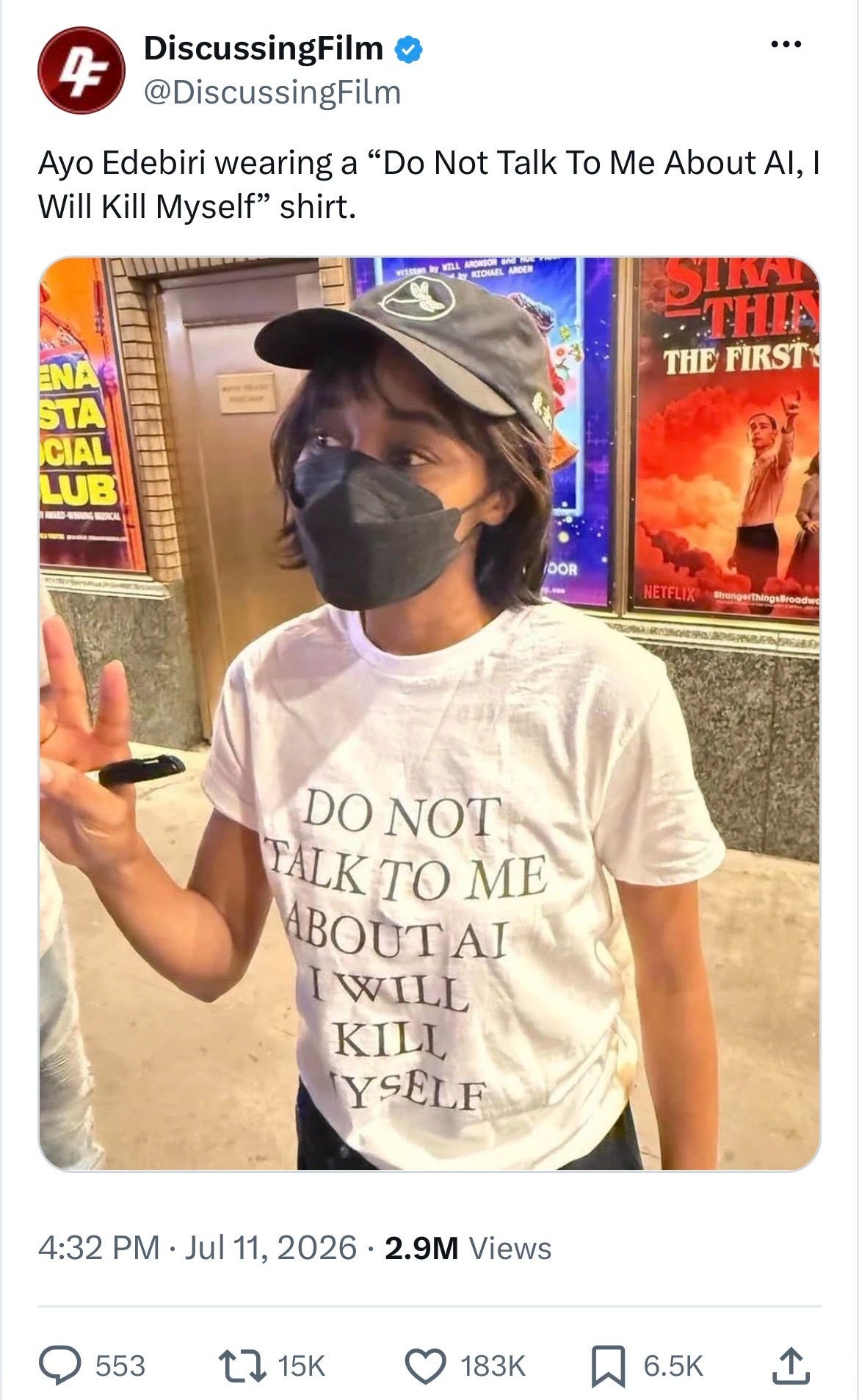
There are legitimate instances where AI can support people and encourage agency in ways other methods could not–or limitations of resources make this incredibly difficult (e.g., “How AI Can Help People with Disabilities”).
However, when it comes to AI for therapy there are, of course, some concerns.
Dr. Tracy Dennis-Tiwary has written a two parter about this that is so well-researched and articulated, I shouldn’t even bother to try to have another take:
In Part One she talks about the first therapy chatbot from the 60’s and some of the “inconvenient truths” we are facing (e.g., more access to therapy doesn’t mean “better”)
In Part Two she explores how these chatbots aren’t “doing therapy” buttttt they could perhaps provide psychological first aid. She also mentions the ways AI could be regulated to protect those most vulnerable to the risks of using it in this manner.
A few stand-out moments for me that I mentally highlighted from Dr. Tracy Dennis-Tiwary’s series:
“A.I. therapy might become useful, but one of its greatest risks is that it keeps us mistaking information for wisdom and the consumption of good ideas for change.”
“A.I. can never be therapy because it is essentially self-help on overdrive - a curation of our bloated information ecosystem, packaged as an illusion of empathic concern and a phantasm of a real relationship.”
To answer the question directly—What I think about it is that I personally don’t and wouldn’t use AI for therapy-like feedback. When I have something I want to talk to a therapist about, I am in the very privileged position of being surrounded by them—some in professional contexts, some are my friends. In a lot of ways, I’m not well-suited to answer this question because of that level of access I have. I’m a bit out of touch, ya know?
But, if I took a whack at it, the term discernment comes to mind: Am I able to understand the ways in which this is meant to be addictive and am I able to protect myself from getting stuck in that loop? To Dr. Tracy Dennis-Tiwary’s point, do I need psychological first aid (questions with more of an answer) or do I need deeper support (a state that needs to be sat with, witnessed)? Is the way I’m using AI helping me get closer to a relationship with a human being that is complex and hard and fulfilling? Am I more able to connect and ask for help from a human being after using AI or am I relying on AI so I don’t have to risk the intimacy of dealing with a human?
And listen, I don’t always wanna be dealing with people either. I’m INTRO-verted to the max. I like and accept myself that way, howeverrrrr I think if we are opting out of IRL relationships, we need to be expanding our ability to be with ourselves.
editors note: I had my friend, Caitlin take a look at this piece (shout out ponyyyyy 🐎— you may remember her from here). She added this which is so spot on that I wish I could take credit for it, but alas:
“…you might add that AI cannot pick up on what we can't see in ourselves and how we show up in relationships…and for certain people, or most, they can't see their blind spots. AI is only going to see what you show it. And if you can't see it, well then, no insight.”
I also don’t know what I don’t know. Are there legions of people who are authentically helped by these chatbots? Probably?
I’m gonna be meta here and say instead of looking for the “right” answer to this question, perhaps one AI could give me, I’m going to say I don’t know.
When my son has a curiosity about something, which is often, he will say, “Just look it up.” Each time he says this, I can’t help but think of that scene from Noah Baumbach’s While We’re Young when during a conversation between two couples, a question comes up about a term they can’t recall and the understandable instinct to just look it up plays out. The younger couple responds, “Let’s just not know.”
I answered this in a very convoluted and nuanced way. Which is probably why AI will take my job one day 😂
For more: Dr. Tracy Dennis-Tiwary has another series on AI here called “AI and the Attachment Trap” Part One and Part Two. Another great piece on this from Amanda E. White, LPC that speaks to concerns of using chatbots for reassurance.
⚫ How do you know if it’s time to stop therapy?
I regret to report my stance is not a crowd-pleaser: I’m of the belief that no one can answer this but the person asking it.
However, I’ve seen two typical paths toward a therapeutic relationship ending:
(1) It’s pretty clear-cut: You came into therapy to deal with “X.” When you feel resolved about X and there are no more Y’s and Z’s presenting themselves as in need of your attention, it may be time to talk about bringing the relationship to a close.
(2) It’s more ambiguous. There are some signals7 that may indicate it’s time to consider shaking things up. You may find yourself thinking:
“I feel like I’m just spinning my wheels.”
“I constantly have to explain or repeat myself.”
“It feels like they are just not getting it.”
“I feel like I want a bit more space to engage in utilizing what I’m learning rather than reflect on it.”
“I want to try a different approach.”
I’ve often written about how, for me, a lot of these are signs to pause, not necessarily stop outright.
These feel like sister questions to the ones we are often faced with in the relationships in our personal lives: Can this be resolved within the relationship? Is there utility and healing in that attempt? Is it time to respectfully go our separate ways?
Remembering the ending is not a “bad” thing necessarily, but there can be inherent grief in that.
As I mentioned before, I will be in therapy and healing relationships of all kinds for the rest of my life—e.g., consultation groups with my peers, sobriety meetings, individual, couples and family therapy, acupuncture and other body work. Not because I think there is something irretrievably broken in me that requires fixing or constant vigilance, but because leaning on and receiving support and wisdom is one of the most beautiful ways to connect in this life, IMO.
I think it’s magic when what you need and what someone else has to offer—their gifts—come together.
Not to mention, there are parts of me that need and deserve care. What type of care that is will shift over time, but I’ll always need it.
⚫ What would you say to someone who thinks they could benefit from therapy but would be jeopardizing their job by going?
Ooof.
My first response is anger and sadness at this reality I know many have to face: one’s financial and professional security and identity being threatened by the care they may need.
My second is all sorts of curiosity: What does jeopardizing mean here? What do we mean by benefit from?
In the U.S., there are protections in the Americans with Disabilities Act that are meant to shield against discrimination in the workplace regarding mental health diagnoses and treatment—this doesn’t mean there isn’t still discrimination, of course. But feeling informed about one’s rights can be a helpful first step—here is a fact sheet with more information on the legal side of things.
There are organizations that are working to address the barriers to treatment for professions where there are more unwritten risks in reporting any sort of mental distress or need for care (e.g., The American Board of Professional Psychology wrote about addressing the hurdles physicians face in getting mental health support—paging Dr. Robby).
I’m going to assume by the way the question is asked, this person isn’t in immediate crisis. If I’m misunderstanding that and this is more emergent, the momma bear in me says nothing is more important than them getting the support they need—and this will likely include addressing the grief around how that support could impact an identity they hold dear (not to mention the likely financial implications).
If:
they aren’t in crisis and are simply wanting more support in relating to themselves differently, dealing with stress, gaining skills, etc.
—and—
this is a job they either really love and/or need to stay in for whatever reason and seeing a therapist is off the table
…branching out more widely in what kind of care they are open to could be another option (e.g., working with a coach, support groups, reiki, yoga, acupuncture, massage, writing, finding books that speak to what they are looking to explore, I’ve been on a kick lately of researching one’s ancestoral healing practices).
As I mentioned earlier, I look at therapy as one avenue of many in taking care of oneself. Just like a tool box isn’t filled with only hammers, we are most equipped for a full life—whatever that means to us—when we are acquainted with a wide array of support and connection.
🧰
That’s it for today.
Our next AMA will be full of juicy questions about relationships 🍑 (e.g., how do we learn how to apologize, polyamory, which relationships are worth saving, making mom friends.)

Questions & Considerations for you:
I think it can be surprising for students how much of becoming a therapist is dealing with our own stuff. I’m curious, what is a thing that surprised you about your profession once you were in it?
Have you used AI for mental health support? What was your experience like? Do you have concerns about it as a resource?
If you’ve been to therapy and stopped, how did you know it was time?

Reminder: Our book club + workshop series, The Summer I Learned How to Let Myself Be Bad on Elise Loehnen’s On Our Best Behavior: The Seven Deadly Sins and the Price Women Pay to Be Good, is underway. We’ve covered Sloth, which you can catch the replay here, yesterday we talked about Envy & Pride (it was amazing and that replay will available soon), next up is Gluttony & Greed in August!! You can get tickets here.8
🚨 these workshops are part of a paid membership. upgrade to get your access today 🚨
Disclaiming: Therapy can be great. This ain’t therapy. You can find more info and my full disclaimer on my about page here. Abridged version: I’m a therapist, but not your therapist—even if you are a client of mine ~hi, dear one!~ this isn’t a session. I don’t think you could possibly confuse this newsletter with mental health treatment. Alas if that were to happen, let me say definitively, dialoguing is an entertainment and informational newsletter only, not a substitute for mental health treatment.9
Come say hi! Any comments, questions, suggestions, please feel free to email me at dialoguingsubstack@gmail.com—or if you’re reading this via email you can hit reply and send me a message. Love hearing from you for any and all reasons!
say more #28: notes from another week in *living*—convincing my shame rollercoaster to drop me off somewhere I wanna be🎢, the best movie I’ve seen in awhile and decoupling pain from identity. boop boop.
🪄 here is to every space that had some magic to it 🪄—saying goodbye to my office
say more #27: notes on the past few weeks in *living*—Zendaya, introversion and how I’m dealing with rumination RN.
what if rest was closer to us than we thought?—REPLAY of the first session of our workshop + book club series: Sloth 🦥
say more #26: 10 notes on this week in *living*—a follow up on how my commitment to “having a summer” is going, an invitation to learn about healing from our ancestors, and a movie I love but just can’t write about
If this spoke to you and you’d like to support my work, there are lots of ways to show that love:
❤️ || restack || come hang in the comments
Share with a friend!
Check out my ShopMy page
Upgrade to a paid subscription (grants access to the entire archive, round-ups ~2-3x/month, free workshops—like the one mentioned above or this one on connecting time and values, exclusive In Session with Pop Culture editions about current TV shows—we covered season 3 of Shrinking and will be getting into Ted Lasso when it returns next month!)
Whether it’s your hype, eyeballs or dollars, I’m so grateful for your support of any kind <3
This newsletter gets into several different areas of exploration.
With the Let’s Talk Therapy questionnaire I get to ask my favorite Substackers about their relationship to therapy.
In Session with Pop Culture is a series where I watch TV shows and movies or listen to a new album with my therapist hat on.
say more are round-ups that cover what I’ve been up to—watching, reading, listening to, eating, wearing, moving to and learning—and what it made me feel.
If you’d like to receive some of these sections but not others, you can go to your account settings to opt in and out. Lifestyle content, AMA’s and personal essays, like this one, come through the main dialouging page.
I got my degree in Counseling Psychology so I can’t speak to other types of programs (e.g., MFT’s, social work, etc.)
This is a term I learned through Dr. Mullan’s book in referencing a statement from Yolo Akili--instead of using “marginalized communities”
Do I need to do a completely unnecessary In Session with Pop Culture on this summer blockbuster from 1998?
e.g., googling things, you can’t remove AI overviews through a setting (yet?), but you can add “-AI” to your search and it will remove AI-generated content from the search page.
“The green paradox: The climate, environmental, and sustainability implications of artificial intelligence” by Apoorva Chouksey , Aneha K. Rajan , Vikas Gurjar , Rajnarayan Tiwari , Pradyumna Kumar Mishra in Global Environmental Changes Advances Volume 6, March 2026, 100029 || “AI’s environmental costs threaten water, land and climate” from the UN’s website, June 4th, 2026
Obviously in situations of abuse or boundary violations in the therapeutic relationship are also a sign to stop and receive further support elsewhere.
Remaining Schedule:
Sunday August 9th from 10-11:30 am MST || Gluttony & Greed
Sunday September 13th from 10-11:30 am MST || Lust & Anger
Sunday October 4th from 10-11:30 am MST || Bonus Sin: Sadness + Closing
To find a mental health provider, Psychology Today or Zencare can be a place to start. || There are affiliate links on this page! That just means if you click on a link, find something you like and buy it, I’ll make some cash. Don’t worry, you won’t pay any extra. You can check out my Bookshop.com storefront here and ShopMy here.
Nice to hear you discussing all these issues, Kaitlyn. I'm getting asked that question about AI a lot these days. My response is usually: Until AI can soothe a crying baby, it won't be a replacement for therapy. We need to be seen, held, and witnessed. We need a body in the room that we can co-regulate with.
I am shocked at how little appreciation I get as an attorney- as a young law grad I thought I saw more gratitude from clients. I think AI is part of the shift now that many clients don’t recognize skill levels and think they can do equally well themselves especially in terms of negotiating a settlement.
I often tell potential clients they are paying me to worry about something they could do themselves, but I will have the experience to gather information more quickly and know what avenues to take. As a private practice owner, I am very lucky to have my mom to handle so much of the business administrative side of our firm, her office management skills are invaluable, neither my dad nor I have the perspective that she does for long range business planning.
I’ve never talked to AI about anything I would ask a therapist, I don’t know that I will ever feel “done” with therapy because I don’t think I’m trying to “fix” something about myself. I think it’s one of my tools of support and how I process my life currently and I appreciate having my therapist alongside me for that processing.
The only other time I went to therapy was a few appointments with student health when I was having a very hard time with my roommate and one of my best friends at the end of junior year and couldn’t figure out how to have tough conversations with them. I didn’t go back because I went home for the summer and I felt ashamed of needing help at that time and kept wondering what was wrong with me. I didn’t have enough time to establish a great rapport with that counselor and I felt very eager to pronounce myself “healed.” Looking back now, I wish I had been more open to therapy in my early 20s, it would have been nice to have that support especially when I was moving to a new city, separating from my twin for the first time in my life starting law school, and accepting that I was never going to be with my ex long term. It was a pretty rough few months and I wasn’t making great decisions.